Crafting Your Actionable Affiliate Agreement Contract

Written by Ayo Abdul

Imagine launching a new business partnership. You wouldn't seal the deal with just a handshake. That's exactly what an affiliate agreement contract is for your affiliate program—it’s the official playbook for a healthy, profitable relationship. To make it effective, treat it less as a legal hurdle and more as a practical tool for driving growth and preventing conflict.
Jumping into an affiliate partnership is an exciting way to grow, but doing it without a solid contract is like setting sail without a map. A well-crafted affiliate agreement is your best tool for turning that potential chaos into a well-oiled, scalable revenue engine.
This document is more than just legal protection. It’s the rulebook that gets everyone on the same page, defining the entire relationship between you (the merchant) and your partners. When both sides know exactly what actions to take and what to expect, trust builds, and that's the real secret to a long-lasting partnership.
A quick email or a verbal "let's do this" might seem sufficient when you're starting out. But as your program scales, that casual approach will break down. What specific steps do you take when a commission payment is disputed? Or when an affiliate promotes your brand in a way you never intended? An actionable contract answers these questions before they become problems by getting every critical detail down in writing.
An effective affiliate agreement elevates the relationship from a casual arrangement to a true business partnership. By clearly defining the roles, rewards, and rules, it protects your brand while giving affiliates the confidence they need to do their best work.
This document is fundamental for growth. It’s not just about putting out fires; it’s about giving your affiliates a clear path to success. When partners understand the commission structure and the marketing guidelines, they can promote your products with more creativity and focus. This structured freedom is what makes the best affiliate programs thrive.
This need for clear, established rules is a cornerstone of the entire affiliate marketing world. It’s a massive industry—valued at an estimated $18.5 billion in 2024 and on track to hit over $31.7 billion by 2031. At the heart of this explosive growth are the affiliate agreements that provide the legal backbone for millions of partnerships. They set the terms for everything from payout rates to promotional rights. You can find more details about the affiliate marketing industry's growth on Hostinger.com.
Ultimately, a strong contract helps you:

Think of your affiliate agreement contract as the blueprint for your entire partnership. The real skill is translating dense legal language into a practical guide that both protects your business and genuinely motivates your affiliates.
A vague contract invites trouble. By getting specific with these essential clauses, you're not just creating rules; you're preventing future arguments over payments, brand use, and performance. Let’s break down the most important parts that make an agreement a powerful tool for growth, not just a formality.
This is the heart of the agreement and the first thing potential affiliates look for. It needs to be airtight. Simply stating a percentage isn't enough; you must spell out exactly what action triggers a commission.
Any ambiguity here will cost you. For example, if you don't specify your cookie-tracking window, an affiliate might assume they get credit for a sale made 90 days after their link was clicked, while your system is set to only 30 days. That’s an instant payment dispute that kills trust.
Your contract must clearly answer:
Once an affiliate earns a commission, their next question is, "When and how do I get paid?" Clear, reliable payment terms are fundamental to keeping your partners happy. Nothing makes a great affiliate leave faster than delayed or confusing payments.
Your affiliate agreement contract must be the ultimate guide to your payment process, laying out the entire timeline and method so no one is ever left guessing.
A transparent payment clause is a sign of a trustworthy program. It tells affiliates you're organized, reliable, and that you value their work. That's what encourages them to go the extra mile for your brand.
Make sure you include these key details:
This clause is your brand's bodyguard. It's where you define the rules of engagement—what affiliates can and cannot do when promoting your brand. Without clear rules, you open the door to having your business associated with spammy tactics or misleading promises, which can do lasting damage to your reputation.
A classic example is prohibiting affiliates from bidding on your branded keywords in paid search ads. If an affiliate starts bidding on "Your Brand Name," they're suddenly competing directly against you, driving up your own ad costs and creating confusion for customers.
Your agreement should set clear rules on:
With the boom in performance advertising, these contractual details have become more critical than ever. In fact, well-defined affiliate contracts are a core part of the strategy for over 80% of advertisers. These agreements are essential for laying out everything from payment rules to marketing restrictions, ensuring everyone stays compliant and the partnership succeeds. You can dig into more statistics about the power of affiliate agreements to see just how foundational they are to the industry.
Finally, every good contract needs to protect your brand assets and define a clear exit strategy. The intellectual property (IP) clause dictates how affiliates can use your logos, trademarks, and creative materials. Grant them a limited, non-exclusive license to use only approved assets for the sole purpose of promoting your products.
The termination clause spells out how and why the partnership can end. A weak termination clause can turn a breakup into a drawn-out mess. For instance, if your contract doesn't allow for immediate termination for something like fraud, you could be stuck paying commissions to a bad actor while you go through a lengthy dispute process.
Your termination clause must specify:
Think of your payment terms as the engine of your affiliate program. A well-designed payment structure, spelled out in your affiliate agreement contract, isn't just about cutting checks. It’s about creating powerful incentives that encourage the exact actions that will grow your business.
It’s tempting to just pick a simple, flat commission rate and call it a day. But the right model can push affiliates to find high-value customers, promote long-term loyalty, or drive a massive surge in traffic during a crucial campaign. The goal is to build a win-win system where your partners are genuinely excited to achieve the outcomes you care about most.
There’s no single "best" commission model. The right choice depends entirely on your business. A SaaS company that relies on customer retention has different needs than an ecommerce store trying to move a high volume of products. Whatever you choose, your affiliate agreement contract must define it clearly to prevent any future confusion.
Here are a few of the most effective structures to consider:
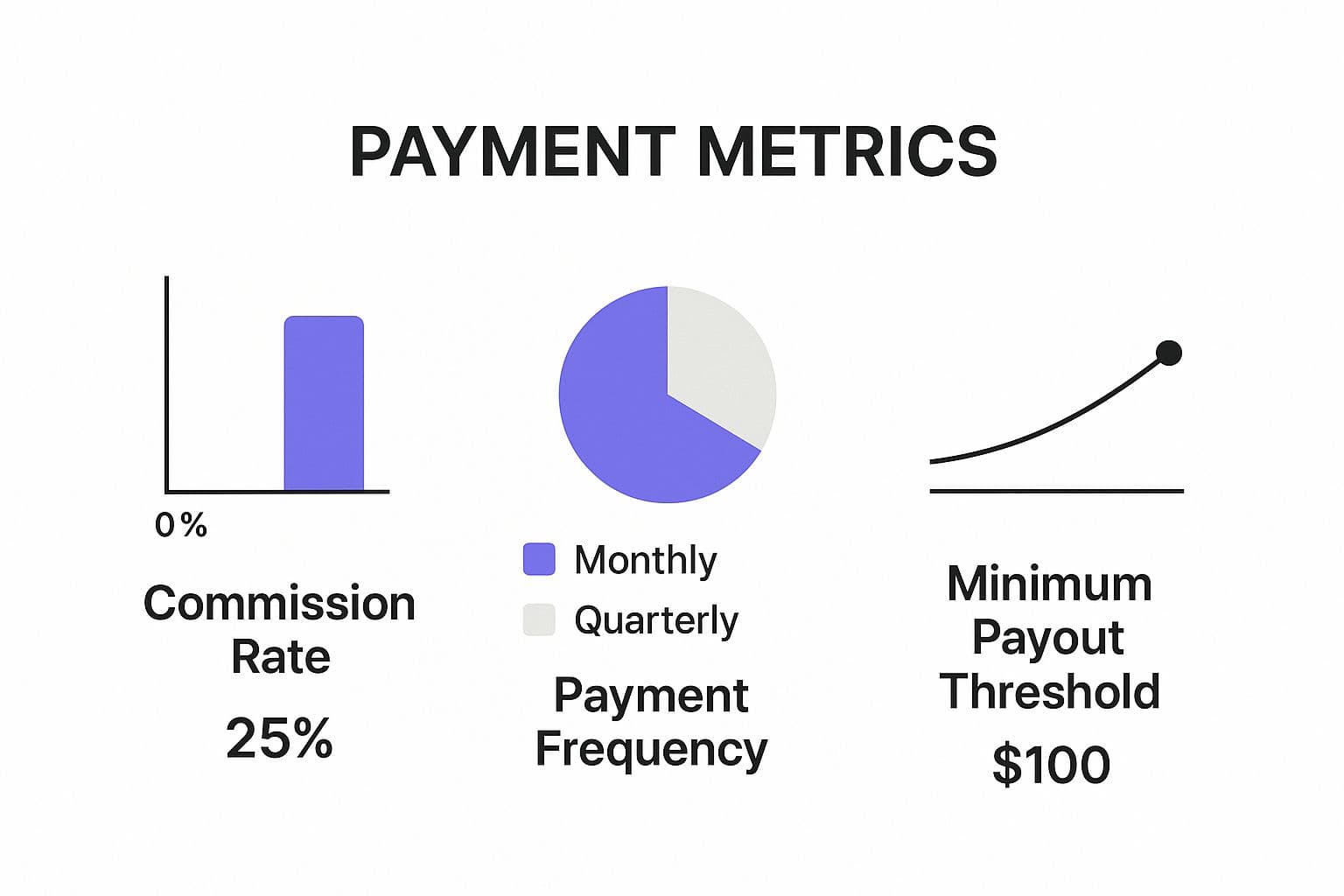
Finding the sweet spot between an attractive commission rate and manageable payout logistics is what makes a program sustainable for the long haul.
Choosing the right structure can feel overwhelming. This table breaks down the most common models to help you see which one aligns best with your specific business goals.
| Commission Model | Best For | Pros | Cons |
|---|---|---|---|
| Pay-Per-Sale (PPS) | Ecommerce, product sales | Simple to understand; directly ties reward to revenue. | May not incentivize high-value customers; can lead to lower-quality traffic. |
| Pay-Per-Lead (PPL) | Lead generation, service businesses | Good for building a sales pipeline even without an immediate sale. | Requires strong lead validation to prevent fraud; conversion to sale isn't guaranteed. |
| Tiered Commissions | Scaling programs, motivating top performers | Encourages high performance and affiliate loyalty. | Can be more complex to track and manage; may demotivate lower-tier affiliates. |
| Lifetime Commissions | Subscription services (SaaS, memberships) | Promotes long-term customer value and retention. | Higher potential long-term payout; requires robust tracking. |
Ultimately, the model you choose sends a clear message to your affiliates about what you value. Take the time to pick the one that best reflects your core objectives.
Once you’ve landed on a commission model, you need to nail down the nuts and bolts in your affiliate agreement contract. These details are just as important for building trust. Any gray area here is a recipe for disputes and demotivation.
Consider this: affiliate programs governed by clear agreements are a huge force in commerce, driving around 16% of all online transactions. In high-growth sectors like SaaS, affiliates often expect commission rates from 20% to 70% because the models reward bringing in long-term value. With over 81.4% of affiliate-promoted products being business-to-consumer (B2C), the clarity of your payment terms is absolutely critical for standing out. You can discover more trends in affiliate marketing payments to see how you stack up.
Your payment schedule and threshold aren't just administrative details; they are signals of your program's professionalism and reliability. A clear, consistent payout process builds the trust necessary for affiliates to invest their time and resources into promoting your brand.
To make your payment system fair, efficient, and dispute-proof, your contract must clearly state:
By meticulously defining these financial terms, your affiliate agreement contract transforms from a simple legal document into a strategic tool. It not only prevents headaches but also actively aligns your partners’ goals with your most important business objectives.

While payment terms motivate your affiliates, marketing guidelines protect your most valuable asset: your brand. Without a clear set of rules, you risk a diluted message and a damaged reputation. A solid affiliate agreement contract isn't just a legal document; it's your first line of defense, acting as a brand stewardship guide for every single partner.
Think of your brand as a carefully composed piece of music. If every affiliate starts playing their own tune—using off-brand language or unapproved promotions—you get noise, not a symphony. This section of your agreement is the official "sheet music" that ensures everyone plays in harmony.
One of the most critical rules to implement is a ban on bidding for your branded keywords in paid search ads. When an affiliate bids on terms like "Your Brand Name," they're not just promoting you; they're competing directly against you. This immediately drives up your own advertising costs on platforms like Google Ads and Bing Ads and can confuse customers.
Your affiliate agreement contract needs to be crystal clear on this point. Explicitly forbid bidding on your trademarks, brand name, and any common misspellings or variations. This one clause can save you thousands in wasted ad spend.
Your brand is built on trust and consistency. Allowing affiliates to bid on your branded terms creates a fractured customer experience and undermines your own marketing investment. A clear prohibition in your contract is non-negotiable for brand protection.
To give this rule teeth, specify that any commissions generated from traffic that comes from forbidden paid search campaigns will be voided. The financial consequence is a powerful deterrent to ensure everyone follows the rules.
How your affiliates talk about your products matters just as much as where they promote them. You must draw a firm line on the language they use to prevent misleading claims that can destroy your brand's credibility. For example, an overzealous affiliate promising a "guaranteed cure" for a wellness product can land your business in serious legal and reputational hot water.
Your contract should spell out what's okay and what's not. Use a simple list of do's and don'ts to give them clear guardrails.
Sample 'Do's and Don'ts' Table:
| Do ✅ | Don't ❌ |
|---|---|
| Do use the official product descriptions from your affiliate portal. | Don't make up your own product claims or guarantees. |
| Do accurately highlight key features and benefits. | Don't use hype words like "miracle," "cure-all," or "risk-free" unless explicitly approved. |
| Do represent the brand in a positive, professional light. | Don't use spammy tactics like unsolicited bulk emails or aggressive pop-ups. |
Finally, your agreement needs to cover the use of your creative assets—your logos, banners, and product shots. You should grant affiliates a limited license to use only the official, approved assets you provide. This prevents the headache of seeing your logo stretched, distorted, or used in a way that looks unprofessional.
Make it clear that affiliates cannot alter your creative assets in any way without getting written permission first. This ensures that whether a customer sees your brand on a major blog or a niche social media page, the experience is consistent. Laying out these guidelines in your affiliate agreement contract gives your partners the clarity they need to promote you well, all while protecting the brand you've worked so hard to build.

Running an affiliate program isn't just about managing partners and tracking sales; it's about adhering to serious legal rules. Compliance isn't optional; it's the bedrock of a trustworthy, sustainable brand. Your affiliate agreement contract is your most important tool for ensuring everyone plays by the same set of rules.
This is about creating a culture of honesty that protects your business, your partners, and your customers. The consequences of getting this wrong can be severe, from major fines to a complete erosion of trust.
At the core of affiliate compliance are disclosure rules, especially those from the Federal Trade Commission (FTC) in the United States. The FTC's guiding principle is straightforward: if a relationship could influence an endorsement's credibility, you must be upfront about it. Your contract needs to make it crystal clear that affiliates must follow these rules.
This means you must spell out exactly what an acceptable disclosure is. A vague statement tucked away in a website's footer is not enough. The disclosure needs to be obvious and easy to spot.
Your affiliate agreement contract should demand specific actions:
According to the FTC's endorsement guides, if a consumer doesn’t know about a material connection, the endorsement is considered deceptive. Your agreement is the mechanism you use to enforce this transparency and keep your program clean.
Beyond disclosure, data privacy is a huge deal. Laws like the General Data Protection Regulation (GDPR) in Europe and the California Consumer Privacy Act (CCPA) have set a high bar for how companies handle user data. Your affiliate agreement needs to tackle this head-on.
The goal is to define who is responsible for what. Your contract should clearly state that affiliates are accountable for their own compliance with data privacy laws on their websites and channels. This means they are responsible for getting the right consent before using tracking cookies or gathering user information.
This clause is your legal shield. It clarifies that while you supply the tracking links, your affiliates are the ones who must use them in a compliant way. This helps insulate you from liability if a partner doesn't follow the rules.
By embedding these legal requirements directly into your affiliate agreement contract, you're doing more than just checking a legal box. You're building an ethical program built on a foundation of transparency—and that's the only way to achieve real, long-term success. While this isn't formal legal advice, it highlights the critical issues you need to address with your legal counsel.
Think of your affiliate agreement contract as a shield. It’s there to protect you from future headaches, but even the best shield can have weak spots. The quickest way to build a strong, reliable agreement is to learn from the mistakes others have made. By spotting these common traps ahead of time, you can save yourself from costly arguments and protect your brand's reputation.
Far too many agreements crumble because they’re built on assumptions instead of clear specifics. A detail that seems small at the outset can easily snowball into a full-blown conflict. Let's walk through the most common pitfalls I've seen businesses and affiliates fall into, and more importantly, how you can sidestep them completely.
One of the most common—and easily fixable—mistakes is using vague language. Terms like "reasonable marketing efforts" or "high-quality traffic" might sound official, but in a legal document, they’re practically useless. Why? Because they mean different things to different people, creating a perfect recipe for a dispute.
For instance, if you don't spell out exactly what a "qualified sale" is, you're asking for trouble. An affiliate might think they've earned a commission on a product that a customer later returned, while you see that sale as void. To avoid this mess, you have to be crystal clear.
A poorly written termination clause can trap you in a bad partnership with no simple exit. Many contracts either don't specify the reasons for immediate termination or make the process painfully slow. This becomes a massive liability when you catch an affiliate using black-hat tactics.
Imagine finding out an affiliate is using cookie stuffing—a sneaky tactic where they drop tracking cookies onto a user's computer without permission. Without a clause that allows you to terminate immediately for fraud, you could be stuck paying them while you sort out the mess, all while your program's integrity takes a hit.
A well-defined termination clause is your emergency exit. It must clearly outline the conditions for an immediate and clean break, protecting your business from bad actors and preserving the health of your affiliate program.
Your contract needs to explicitly state the grounds for immediate termination—things like fraud, breaking your marketing rules, or failing to follow disclosure laws. It should also define the standard notice period for ending the agreement for other reasons, giving both you and the affiliate a fair and predictable way out. Addressing these exit strategies upfront in your affiliate agreement contract builds a safer, more transparent foundation for everyone.
Getting into affiliate marketing often brings up a ton of questions, especially around the legal stuff. Think of a solid affiliate agreement contract as your playbook—it provides the clarity and security you need to build strong partnerships. Let’s break down some of the most common questions we hear from both merchants and affiliates.
Absolutely. In fact, starting with a professionally drafted template is a smart move. A good template, particularly one a business lawyer has looked over, makes sure you don't miss any critical pieces like payment terms, marketing rules, and how the partnership can end. It can save you a bundle compared to hiring a lawyer to create a contract from scratch.
But don't just find/replace your company name and hit send. You have to customize the template so it perfectly reflects your business and your specific program. This is where you’ll plug in the details that make your program unique, like your commission rates, cookie duration, and any brand-specific rules.
A template gives you the "what" (the essential legal clauses), but you have to fill in the "how" (the specific rules of your game). It's like getting a pre-built house frame—the structure is solid, but you get to pick the paint, flooring, and fixtures to make it feel like home.
When an affiliate steps out of line, your agreement should tell you exactly what to do next. This is precisely why a crystal-clear termination clause is non-negotiable. Your reaction will naturally depend on how serious the breach is.
A minor slip-up might just need a quick warning. But for major offenses, like click fraud or bidding on your company's branded keywords when you've told them not to, your contract should empower you to act swiftly.
When these consequences are clearly spelled out in the affiliate agreement contract from day one, it acts as a strong deterrent and encourages everyone to play by the rules.
Your affiliate agreement isn't a "set it and forget it" kind of document. You should plan on giving it a thorough review and potential update at least once a year. It’s also wise to pull it out any time you make a big change to your business or affiliate program.
Give your agreement a fresh look whenever you:
Regular check-ups ensure your agreement stays relevant, protects you from emerging risks, and keeps pace with your program's goals. And remember, keeping your affiliates in the loop about any changes is key to maintaining a transparent and trusting relationship.
Ready to launch or scale your affiliate program with a platform that simplifies management and growth? Push Lap Growth provides everything you need, from a branded portal and real-time tracking to automated payouts and a marketplace of qualified affiliates. Start your 14-day free trial today and see how easy building profitable partnerships can be.
Article created using Outrank